


Secrets of Exciting Chords & Chord Progressions: Lesson Twelve
All The 9th Piano Chords
Hello again, and welcome to the next edition of the newsletter. I hope you are enjoying learning about all the piano chords in the world — and we’re going to cover them ALL before we’re done — you’ll know more about piano chords than 99% of the people in the world — believe it or not, it’s true.
Last time we covered maj7th chords. That was the last of the piano chords you can play without doing some fancy manuvering. Today we’re going to learn 9th chords, and from now on we will be inverting the chords and using a 2-step process to play the piano chords.
A 9th chord is made up of a root, a 3rd, a 5th, a 7th (not the maj7th — just the 7th) plus the 9th note of the scale, which of course is the same as the 2nd note of the scale, but an octave higher.
Why don’t we call it a “2nd”, then, instead of a 9th? Because the chord has a 7th under the 9th, whereas a 2nd wouldn’t have a 7th under it.
So:
| A 9th Piano Chord = Root 3rd 5th 7th 9th Add the 9th note of the scale to the 4-note 7th chord — therefore we have a 5-note piano chord. |
What’s the problem with a 5 note piano chord? Nothing, except if your hand is small like mine. I can’t reach all 5 keys, so I had to come up with another way to position the chord on the keyboard. (And even if your hand is big enough to reach a 9th, you won’t have enough fingers to play an 11th or 13th! So you have to come up with a way to play those humungous chords, and this is the best way I’ve found — though not the only way.)
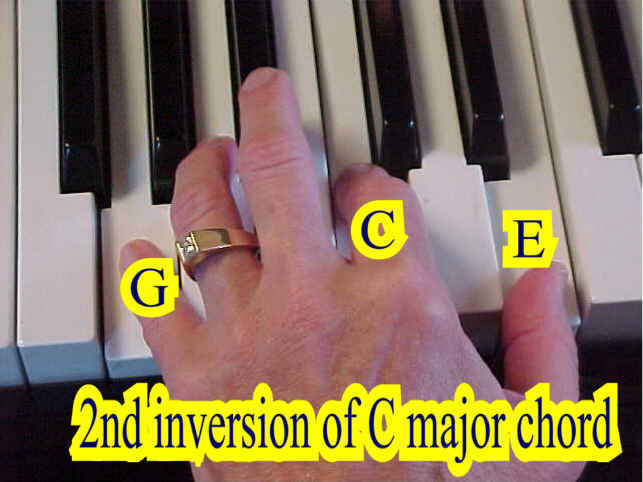
What we do is this: Get your left hand in 2nd inversion on the piano keyboard like this (we’ll use the C chord to illustrate):
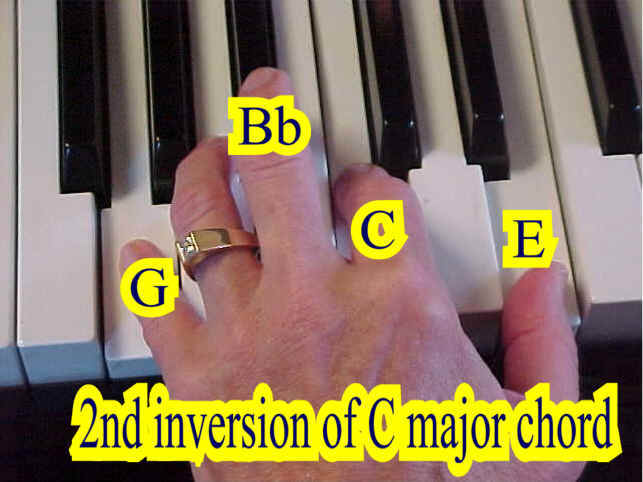
Then add the 7th to the piano chord:
Now take your index finger off “C” and play “D” instead, like this:
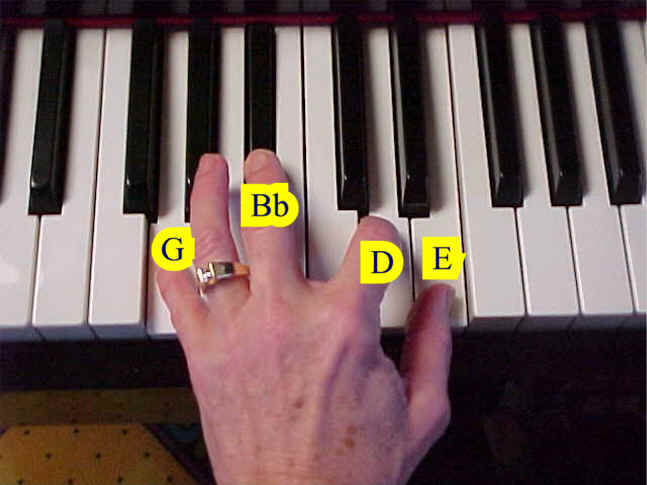
You may be saying “But how could that be a C9 chord? It doesn’t have a C in it!”
And you would be right.
So what we need to do is to play the C — the root of the chord — an octave below middle C while we depress the sustain pedal, and then play the chord shown above.
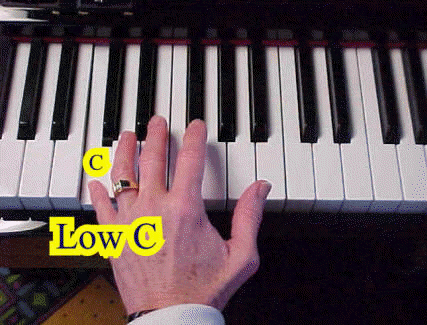
The sustain pedal hooks the two parts together to make one cohesive chord — a C9.
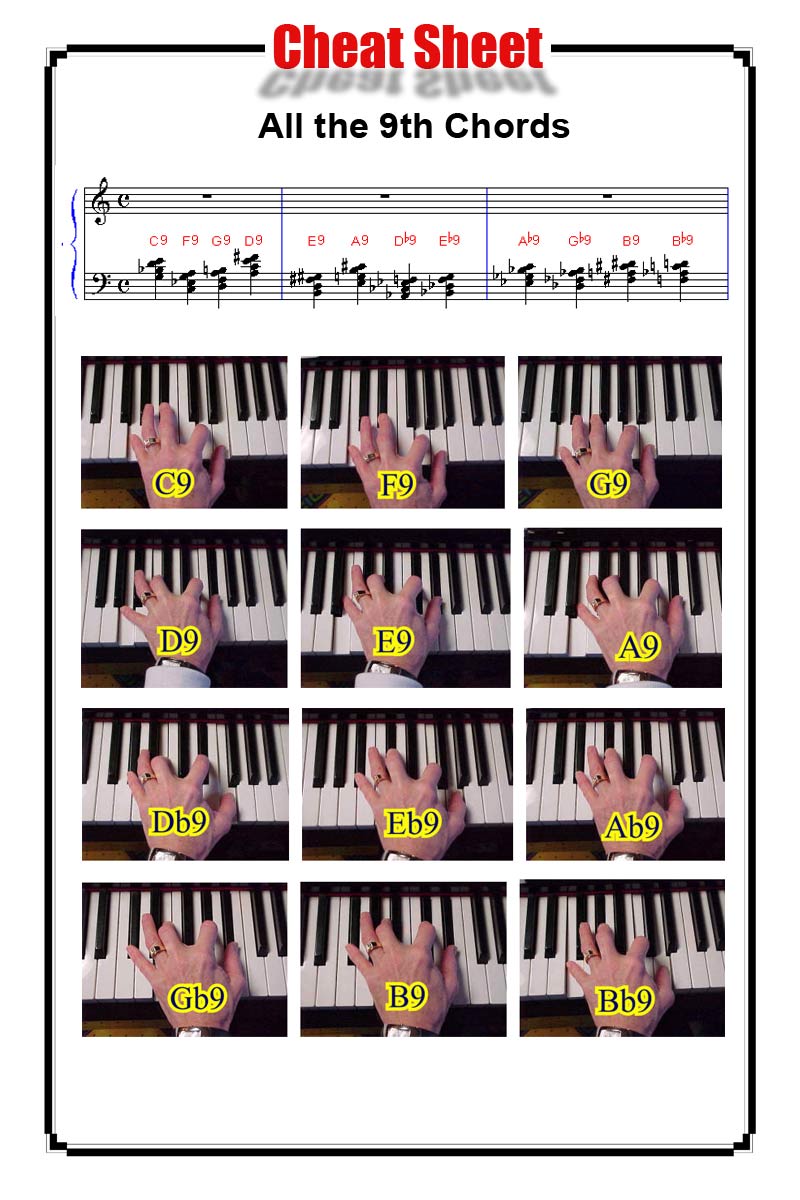
So if you want to play a F9 chord, you would play a low F (the root of the F chord) low on the keyboard, then play the F9 chord while the sustain pedal is depressed. Same for any other 9th chord — play the low root, then the chord.
Here’s what 9th chords look like on the staff:(Remember that accidentals carry over in the same measure!)
You may be wondering if you can play 9th chords in different inversions, like you can invert 6th and 7th chords. The answer is “sure” — but if I were you I would master one inversion before trying to use several different ones. When you’re dealing with this many chords, it’s easy to get turned around and confused. So unless you have a very good reason to use a different inversion, I would stick with only one inversion for now.
As usual, now it’s up to you. Play each 9th chord in root position, then 1st inversion, then 2nd inversion, then in 3rd inversion (the 7th will be the lowest note of the chord) Play each chord up and down the keyboard for at least 2 octaves — maybe 3 octaves. Play them with your left hand, then play them with your right hand. Then play them hands together.
Go through all 12 major chords, inverting every one. Then go through all the 12 minor chords, inverting each one up and down the keyboard — hands alone, then hands together. Then go through all 12 diminished chords, inverting each one up and down the keyboard — each hand alone, then together. Then play the 12 augmented chords, up and down the keyboard. Then skip around from major to minor to diminished to augmented, etc.
Then add minor 6th chords to your repertoire of chords. They are shown in root position above, but you know that you can turn them upside down ’till the cows come home — invert them — so go to it!
And then add 7th chords and their inversions….then add the maj7th chords we’ve learned last lesson
Then finally, add these 9th chords into the mix — but don’t forget to play the low root before playing the chord — that’s a must!
Do you feel like you’re getting a handle on chords yet? You ought to — I know we’re going slowly, but chords are SO important that you absolutely MUST master them if you are ever going to play the piano like you hope to! So here’s our revised chord scorecard:
| 12 major piano chords to 12 minor piano chords to 12 diminished piano chords to 12 augmented piano chords and 12 major 6th piano chords and 12 minor 6th piano chords and twelve 7th piano chords and twelve maj7th piano chords and 3 or 4 inversions of each and now, twelve 9th piano chords which means you can now play Yea! Three cheers for you! |
Next lesson we will add 12 more chords to our growing list of chords we can play by adding 11th chords to our stash.
Duane has put 36 “secrets of the pros” into 36 one-hour audio CD’s. He explains each technique, then DRILLS you for a solid hour on that technique. You’ll play along with him on each technique until you understand each technique and can execute it by yourself. This is HARD WORK, and not for beginners. The idea is to spend an hour a day for 30 days on just one technique, and then move on to another technique.