



Secrets of Exciting Chords & Chord Progressions: Lesson Twenty-Seven
Chord Progressions Part Eight:
“The ‘II – V7 – I’ Chord Progression”
In a previous issue we established the foundation for chord prediction by learning the primary chords for each key. I hope you internalized that and committed each “family of chords” to memory. (It is re-printed below for those who missed that issue, or are just signing on to this newsletter).
Now that you know “the fam”, today I would like to introduce you to the “cousin” chords. These are chords that don’t occur near as often as the primary chords, but much more often than “neighbor” chords, and way more often than “stranger” chords.
The most likely cousin-chord to show up in any key is the II chord. In other words, after the I, IV, and V chords, the II chord is the next most likely to be used. It might show up in one of several forms — it might be a major chord, it might be a minor chord, it might be a 7th chord — but however it shows up, it is far and away the most likely chord to occur after I, IV, or V.
So in the key of C, that means that some form of the D chord is the 4th most likely chord to occur. Maybe D7, maybe Dm7, maybe just D, but whatever the form, it is like the cousin that likes to show up at dinner time to eat with the fam.
And when it does occur, you can then predict with uncanny accuracy which chord will come after it — the V chord. And after that, the I chord. So if you were a betting person, your odds would go sky high at that point for that succession of chords to occur. In musical terms, this progression is known as the II – V — I chord progression. And it happens over and over and over and over again in countless songs.
So let’s get it down cold. If it happens so much, it’s worth your time to master it both intellectually and hand-wise (in other words, understand it and be able to play it).
Here’s the II, V, I progression in all keys:
| Key of C: D G C
Key of F: G C F Key of G: A D G Key of D: E A D Key of E: F# B E Key of A: B E A Key of Gb: Ab Db Gb Key of Db: Eb Ab Db Key of Eb: F Bb Eb Key of Ab: Bb Eb Ab Key of B: C# F# B Key of Bb: C F Bb |
And here’s what the progression looks like in the keys of C, F, and Bb:
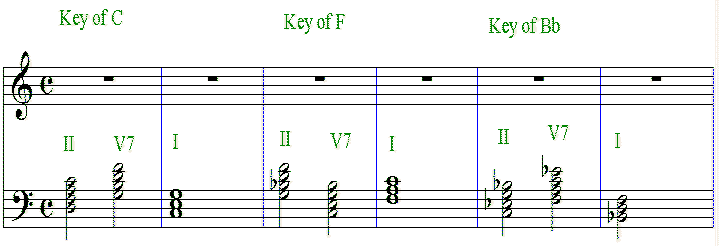
I hope you noticed something about this progression as you were thinking or playing through it. I hope you noticed that each chord is a 4th higher than the previous chord. In other words, in the Key of C, after the D chord is used, you go up a 4th (4 scale notes — in terms of traditional harmony it is a “perfect 4th) to G. Then after the G chord is used, you go up a 4th to C to complete the cycle. If you didn’t notice that, go back and play through these again.
Next issue we’ll meet another cousin, and see where she fits it to the scheme of things as far as chord prediction is concerned.
Meanwhile, you might want to check out “Chord Progressions & The Riffs & Runs That Grow Out of Them.”
It’s a great course if you want to really MASTER chord progressions, because it not only teaches the progressions, but also shows how to create runs and fills out of those progressions, so it’s worth its weight in gold to someone serious about playing really well.