


Secrets of Exciting Chords & Chord Progressions: Lesson Twenty-Nine
Chord Progressions Part Ten
“The ‘Blue Moon’ Chord Progression”
A few lessons ago we learned the most obvious chord progression of all:The “Oh Duh” Chord Progression
- If there are 3 primary chords in a key — I, IV, and V — and there are:
- And since most songs start and end on the I chord — and they do;
- Then the obvious conclusion is that there are only two possibilities for the next chord — the V chord or the IV chord;
- So if the melody note is part of the V chord, then the chord is probably the V chord. (Duh!) If the melody not is part of the IV chord, then the chord is probably not the IV chord. (Duh!)
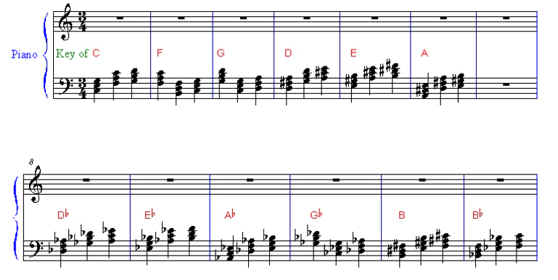
Just to briefly review, here they are again — the 3 most used chords — the primary chords — in each major key:
Then we learned the “creep” chord progression:
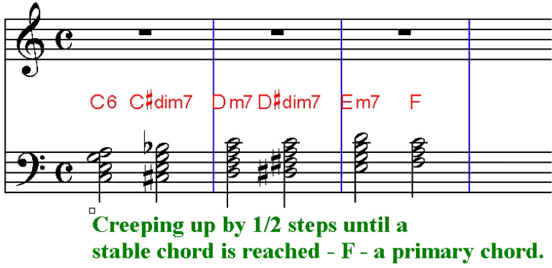
Once the progression reaches a stable chord — usually a primary chord — then it can be combined with one or more other progressions to create an entire song.
Then we learned that 2 or more chord progressions can be combined in one song. That gives the song a form. And forms are named such as:
| Theme Theme Contrast Theme This form is known as A A B A musical form. |
If the song went like this: Theme Contrast Theme …it would be known at A B A musical form. |
| Can you guess what this might be called? Theme Contrast Theme Contrast Theme Contrast Theme Contrast Right you are! A B A B form. |
Can you think of a book of songs made mostly out of A B A B form songs?
Sure. A hymnbook. Verse 1, chorus, Verse 2, chorus, Verse 3, chorus, etc. Whether a hymn has 1 verse or many verses, as long as it has a verse-chorus form it is called A B A B form.
Since every song has a form of some kind, so you can do yourself a HUGE favor and begin to look at songs with an eye to figuring out their musical form!
Why?
Because if you can recognize a song as an A A B A form song, all you have to do is determine the chord progression of the “A” section, and you’ve automatically learned 3/4 of the song! All that remains is learning the “B” section, and you’ve got it
This week I want to share with you the most-used chord progression in the world, bar none. It’s been called the “We Want Cantor” progression, the “Blue Moon” progression, the “Heart and Soul” progression, and other names. I’m going to call it the “2 kids at a piano” progression. The reason I call it that is because when I was a kid I used to play this progression (long before I knew what a progression was!) as a duet along with my brother, or my cousin, or a friend. I’m not a kid anymore, and yet I still hear that progression over and over and over again anytime there is a piano sitting around and a couple kids in the room. One kid takes the top part (the melody), and the other kid plays the bottom part (the chord progression).
You’ve heard it too. At least a zillion times.
The formula is easy: I VI II V
In other words, one measure of the I chord, one measure of the VI chord, one measure of the II chord, and one measure of the V chord. And then repeat as many times as you want, or until some adult says “Would you kids please stop banging on that piano?”
| Blue Moon Progression: I vi7 ii7 V7 |
| So in the key of C, that would translate to: I=C VI=A II=D V=G |
In the key of F: I=F VI=D II=G V=C |
In the key of G: I=G VI=E II=A V=D |
In the key of D: I=D VI=B II=E V=A |
| In the key of A: I= A VI=F# II=B V=E |
In the key of E: I= E VI=C# II=F# V=B |
In the key of Bb: I=Bb VI=G II=C V=F |
In the key of Eb: I=Eb VI=C II=F V=Bb |
| In the key of Ab: I=Ab VI=F II=Bb V=Eb |
In the key of Db: I=Db VI=Bb II=Eb V=Ab |
In the key of Gb: I=Gb VI=Eb II=Ab V=Db |
In the key of B: I=B VI=G# II=C# V=F# |
(And of course, the same would be true in enharmonic keys such as C#, F#, and so on.)
There are many variations to this progression. Usually the two “middle chords — the VI and the II — are played as minor chords, and are then known as vi and ii (use small Roman numerals for minor chords). Usually, too, all the chords except the I chord have a 7th in them –in other words, in the key of C:
C Am7 Dm7 G7
Next week we’ll look at some variations by using “embedded chord subs” in the Blue Moon progression. See you then.
If you haven’t checked out my course on “Chord Prediction: Which Chord Comes Next?” be sure and do so.