



Secrets of Exciting Chords & Chord Progressions: Lesson Thirty
Chord Progressions Part 11
“Embedded Chord Substitutions That Add Spice To Your Arrangements!”
Last week we learned the “Blue Moon” chord progression. Here’s a brief review:
The “Blue Moon” chord progression
The formula is easy: I VI II VIn other words, one measure of the I chord, one measure of the VI chord, one measure of the II chord, and one measure of the V chord. And then repeat as many times as you want, or until some adult says “Would you kids please stop banging on that piano?”
| Blue Moon Progression:
I vi7 ii7 V7 |
| So in the key of C, that would translate to: I=C VI=A II=D V=G |
In the key of F: I=F VI=D II=G V=C |
In the key of G: I=G VI=E II=A V=D |
In the key of D: I=D VI=B II=E V=A |
| In the key of A: I= A VI=F# II=B V=E |
In the key of E: I= E VI=C# II=F# V=B |
In the key of Bb: I=Bb VI=G II=C V=F |
In the key of Eb: I=Eb VI=C II=F V=Bb |
| In the key of Ab: I=Ab VI=F II=Bb V=Eb |
In the key of Db: I=Db VI=Bb II=Eb V=Ab |
In the key of Gb: I=Gb VI=Eb II=Ab V=Db |
In the key of B: I=B VI=G# II=C# V=F# |
(And of course, the same would be true in enharmonic keys such as C#, F#, and so on.)
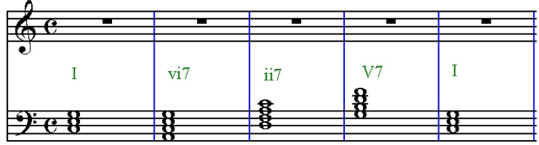
There are many variations to this progression. Usually the two “middle chords — the VI and the II — are played as minor chords, and are then known as vi and ii (use small Roman numerals for minor chords). Usually, too, all the chords except the I chord have a 7th in them –in other words, in the key of C:
C Am7 Dm7 G7
You can experiment around and find combinations you like — you’re not obligated to use the same exact chords as everyone else!
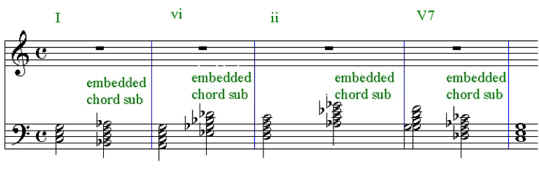
How to “embed chord subs” between the main chordsYou know by now, too, that you can use 1/2 step slides as connective chords between the main chords. For example, if I was playing the progression listed above, I might insert a Bb7 between C and Am7 as a chord substitution. That would let me “slide in” to Am7 in a smooth fashion. Then I might slide into the next chord — Dm7 — from 1/2 step above — Ebm7. Or I might slide into G7 — Ab7 to G7. Or I might slide into C the second time around: G7 Db7 C.
So starting with this:C Am7 Dm7 G7 Which looks like this when notated:
….I might end up with this: C Bb7 Am7 Eb7 Dm7 Gb7 G7 Db7 CQuite a difference! Here’s what it looks like in notation in the key of C:
Experiment around and see what you can come up with. Slide up to chords and down to chords. Make some minor and some major. Add 7ths, add 9ths.
But whatever you do, get this chord progression down cold so you can play it in any key, and recognize it when you hear it. It’s used in a thousand songs, and you can be sure that it will continue to be used in the future in new and creative ways!
If you haven’t checked out my course in Chord Substitutions, be sure to do so. It goes into detail on the principles of substitutions, with lots of examples. Please click on the product below: