

Secrets of Exciting Chords & Chord Progressions: Lesson One
What piano chords do I absolutely, positively have to know?
Click below to hear Duane walk you through this lesson:
As you probably know, there are thousands and thousands of different chords – everything from basic major chords to minor 7ths to 13ths to suspensions to poly-chords. Someday, you might want to learn all those chords if you don’t already know them.
But meanwhile, there are 3 chords — just 3 — that you absolutely, positively have to know. If you don’t know these three, there’s hardly a song in the whole world that you could play. But by knowing just 3 chords, you can play hundreds, if not thousands of songs!
Really?
Really.
Are you ready? Here they are:
I IV V
Huh? What’s all that about?
Here’s what:
In every key there are 3 chords — just 3 chords — which are known as “primary chords” — chords that occur way more than other chords. They are like family members of that particular key. They are groups of notes built on the 1st note of the scale, the 4th note of that scale, and the 5th note of that scale. (Those are 3-note chords called “triads” — later we will get into 4 and 5 note chords.)
For example, here is the C scale on the keyboard. It runs from C up to C and octave higher. The I chord is built on the first note of the C scale, and so on:
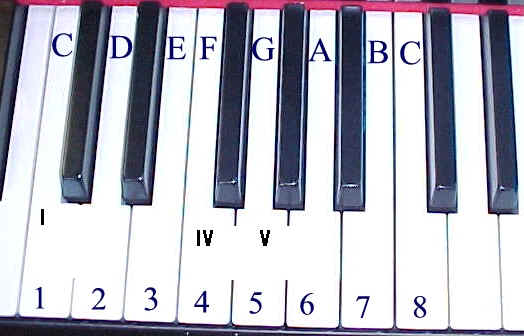
So if I build a chord on the “I” — every other scale note up from C, the chord is C, E, and G — known as the “C major chord”.
If I build a chord on the “IV” — every other scale note up from F, the chord is F, A, and C — known as the “F major chord”.
If I build a chord on the “V” — every other scale note up from G, the chord is G, B, and D — known as the “G major chord”.
Here is what it looks like in music notation:
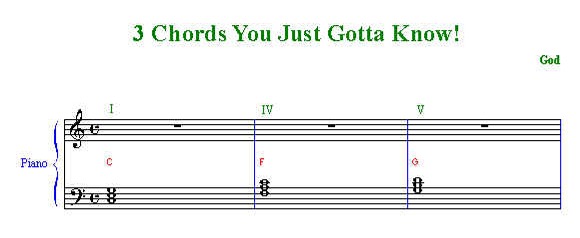
Please notice, if you haven’t already, that those 3 chords contain ALL the notes in the C scale!
So what?
So any melody – tune – in the key of C (as long as it just uses the 8 notes of the scale) can be harmonized just by playing one of those 3 chords!
Think about that — that’s a HUGE insight that most people never get.
So, in any given key you can play in, there are PRIMARY CHORDS — chords that occur way more than other chords. They are like family members of that particular key.
At your house, let’s say you have 3 people in your family — your spouse, your child, and you. On the same block, but down the street a few houses, lives your cousin and her family.
At any given moment, who are the most likely people to be in your house?
The Terminator?
The President?
Yasser?
No sir.
I don’t think so.
It’s possible, of course, but not too likely. If I had to guess, I would say it would be either you, your spouse, or your child. It might be your cousin down the street — there’s a much better chance of that than, say, David Letterman or Prince Charles — but my best odds would be to guess that the family members would be there.
It’s the same way with chords. In any given key, there are 3 “family members” that are residents of that key — the I chord, the IV chord, and the V chord. They are far and away the most likely chords to occur in any given key.
For example, if I am playing in the Key of C, and the first chord is the C chord and I have to guess what the next chord is, I would guess that it would be either the F chord or the G chord. Why? Because those are the other “family members”. So we have narrowed the odds a great deal just by knowing who the members of the family are.
Does that mean that there are always just 3 chords in a song? No, but there are literally hundreds of songs that are made of just 3 chords.
The Primary Piano Chords (“the fam”) Of All the Major Keys
Here are the primary chords (the family chords) of all the major keys (remember that the primary chords are the I chord, the IV chord, and the V chord based on the scale of that particular key):
Key of C: C, F, G
Key of G: G, C, D
Key of D: D, G, A
Key of A: A, D, E
Key of E: E, A, B
Key of B: B, E, F#
Key of F: F, Bb, C
Key of Bb: Bb, Eb, F
Key of Eb: Eb, Ab, Bb
Key of Ab: Ab, Db, Eb
Key of Db: Db, Gb, Ab
Key of Gb: Gb, Cb, Db
Do you have to know all these chords in all these keys?
No.
You can choose to play in just one key, or just a few keys.
But what you MUST know is the 3 chords in whatever key you want to play in! That means that the stark beginner can learn 3 chords in just a few minutes, and be able to play along with thousands of tunes, because most folk songs, hymns, country songs, and many rock songs just use the 3 basic chords. That’s why people who know zilch about music can pick up a guitar, learn 3 chords, and strum along while singing everything from “On Top Of Old Smoky” to “Amazing Grace” to “My Country ‘Tis Of Thee” to “Auld Lang Syne” to “Silent Night” to… well, you get the idea. And not only a guitar, but a piano, keyboard, or whatever.
That’s it for this time.
Next week we’ll expand our horizons a bit, and take an overview of the types of chords available to us in addition to these 3 absolutely essential chords.
See you then.
P.S. If you’re a beginner, or already play but don’t know how to use chords and you’re HUNGRY for more stuff like this, then you’ll absolutely love our How To Play Chord Piano!