"Secrets
of Exciting Chords & Chord Progressions!"
This is the "
Secrets of Exciting Chords & Chord Progressions!" newsletter that you (or someone using your E-mail address) signed up for when you visited our site. If you no longer want to receive these free weekly E-mail piano lessons, toggle down to the bottom of this E-mail and you'll see where you can take yourself off the list. We take your privacy (and ours) very seriously, so we don't want anyone receiving our stuff who doesn't want it! ('cause thousands
really do!).
"
Secrets of Exciting
Piano
Chords &
Piano
Chord Progressions!"
- Special Issue 09 -
Piano
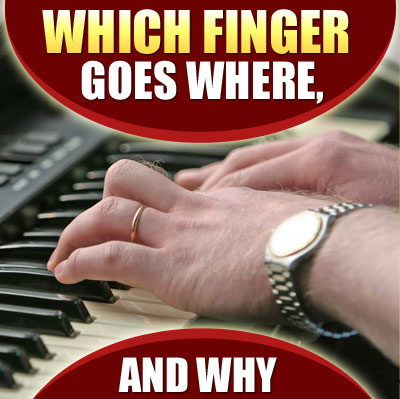
Fingering: The Intrinsic Logic Of Which Finger Should Go Where --
And Why
Here
are some general principles -- the intrinsic logic of fingering:
1. If you see a passage in your sheet music move higher on the staff,
use a low finger (fingers are numbered from the thumb outward, so your
thumb is #1, your index finger is #2, your middle finger is #3, your ring
finger is #4, and your little finger is #5) so you'll have fingers
available for higher notes.
And of course, exactly the opposite if you see a passage move lower on
the staff.
2. Hold your hand up in front of you. The longest fingers are in the
middle -- right? Your thumb is far and away the shortest because it starts
at a lower point on your hand. Now look at a piano keyboard. The black
keys are the furthest away from you -- correct? So which fingers can reach
the black keys best? You got it -- your middle fingers. Therefore,
whenever possible play the black keys with your long fingers instead of
your thumb. It's just common sense.
3. The corollary to that is obvious: use your thumb and little finger
on white keys whenever possible. (And it's NOT always possible.)
4. A scale contains 8 keys. You have 5 fingers. So it's logical to
assume you will have to use some fingers more than once. On right hand
scale passages ascending beginning on white keys, start on your thumb and
then cross your thumb under your 3rd finger except when the 4th note of
the scale is a black key. In that case, to avoid playing the black key
with your thumb, cross your thumb under your 4th finger. (And just the
reverse with your left hand, of course)
On scale passages beginning on black keys, start on a long finger --
preferably your index finger (also called your "pointer finger") and then
cross your thumb under whenever the next white key occurs.
5. On chromatic passages, the best way I have found is to use just
fingers #1 and #3 except where two white keys in a row occur -- then use
fingers #1 and #2.
6. Fingering on chords is largely dictated by the size of the chord;
obviously if you are playing a 5-note chord, you will use all 5 fingers.
Otherwise just follow the intrinsic logic in the general principles listed
above.
This is the "Piano Chords & Progressions"
e-course that you (or someone using your name) signed up for. If you didn't sign up, then go to
the bottom of this page and unsubscribe, because we only want people who
LOVE this stuff to get it! Make sure this newsletter reaches you by calling
your ISP and putting us on your "Mail I want to receive" list and put our address in your address box.
Some SPAM filters actually stop this newsletter from being delivered, even
though the person signed up for it and wants it! And if your SPAM filter
"eats" it, there is nothing I can do about it.
I can't resend it because that is all handled automatically by a 3rd party
auto-responder. So make sure you get it by
calling your ISP (Certain popular ISP's are particularly notorious about
this, so if you have an e-mail account with one of them, please let them
know you want this newsletter!)